The Future of Connectivity: An In-Depth Examination of High-Performance USB-C Solutions
Promo • April 30, 2026
Source: https://www.une.com.tw/catalog/USB_C/
In the swiftly changing realm of electronic interconnectivity, one standard has emerged to lead the industry: USB-C. From the newest smartphones and ultra-slim laptops to industrial automation and automotive systems, the USB Type-C connector has established itself as the universal link for data, power, and video.
However, not all USB-C connectors are identical. For engineers, manufacturers, and technology enthusiasts, grasping the intricacies of USB-C hardware such as those provided by industry frontrunners like Unicorn Electronics which is crucial for developing dependable, future-ready devices.
What Establishes USB-C as the Industry Standard?
USB-C, or USB Type-C, transcends being merely a new plug shape. It signifies a fundamental transformation in our approach to peripheral connections. Its key benefits include:
Reversibility: No longer will users experience the frustration of multiple attempts to connect a cable. The symmetrical design guarantees functionality every time, irrespective of orientation.
Compact Form Factor: Despite its diminutive size (similar to Micro-USB), it accommodates up to 24 pins, enabling substantial data throughput and power delivery.
Versatility: A single USB-C port can manage data transfer, 4K/8K video output (DisplayPort Alt Mode), and rapid charging concurrently.
Analyzing the Speed: USB 3.2 vs. USB 4.0
When searching for USB-C components, the data transfer rate frequently stands out as the most vital specification. Contemporary applications necessitate bandwidth that older standards are unable to deliver.
USB 3.2: The Workhorse
Most premium consumer electronics today employ the USB 3.2 standard. With transfer speeds of up to 20Gbps, it is more than equipped to manage high-speed data storage and high-definition video streaming. Connectors such as the UTC232HF and USB310 from Unicorn Electronics are crafted to fulfill these stringent requirements, providing reliable performance for mid-mount or upright setups.
USB 4.0: The New Frontier
For state-of-the-art applications, USB 4.0 represents the pinnacle of technology. Capable of supporting data rates of up to 40Gbps, USB 4.0 is based on the Thunderbolt protocol. This makes it perfect for external GPU enclosures, high-speed RAID arrays, and professional media workstations. Devices like the UTC237 USB 4.0 Receptacle are designed with high-precision SMT (Surface Mount Technology) to guarantee signal integrity at these high frequencies.
Beyond Data: High Power Delivery and Charging
A major advancement in USB-C technology is Power Delivery (PD). The era when USB was restricted to 5V/0.5A for basic mouse and keyboard power is now over. Contemporary USB-C connectors can accommodate significantly higher current levels. The specialized power transfer series at Unicorn Electronics can manage up to 8A, enabling rapid charging of laptops, medical devices, and industrial tablets. This high-current capability shortens charging times and removes the necessity for bulky, proprietary power adapters, fostering a more sustainable "one-cable" ecosystem.
Specialized USB-C Solutions for Rugged Environments
While standard USB-C ports are suitable for office use, industrial and outdoor settings demand more robust solutions. This is where specialized engineering becomes essential.
Waterproof USB-C (IPX8)
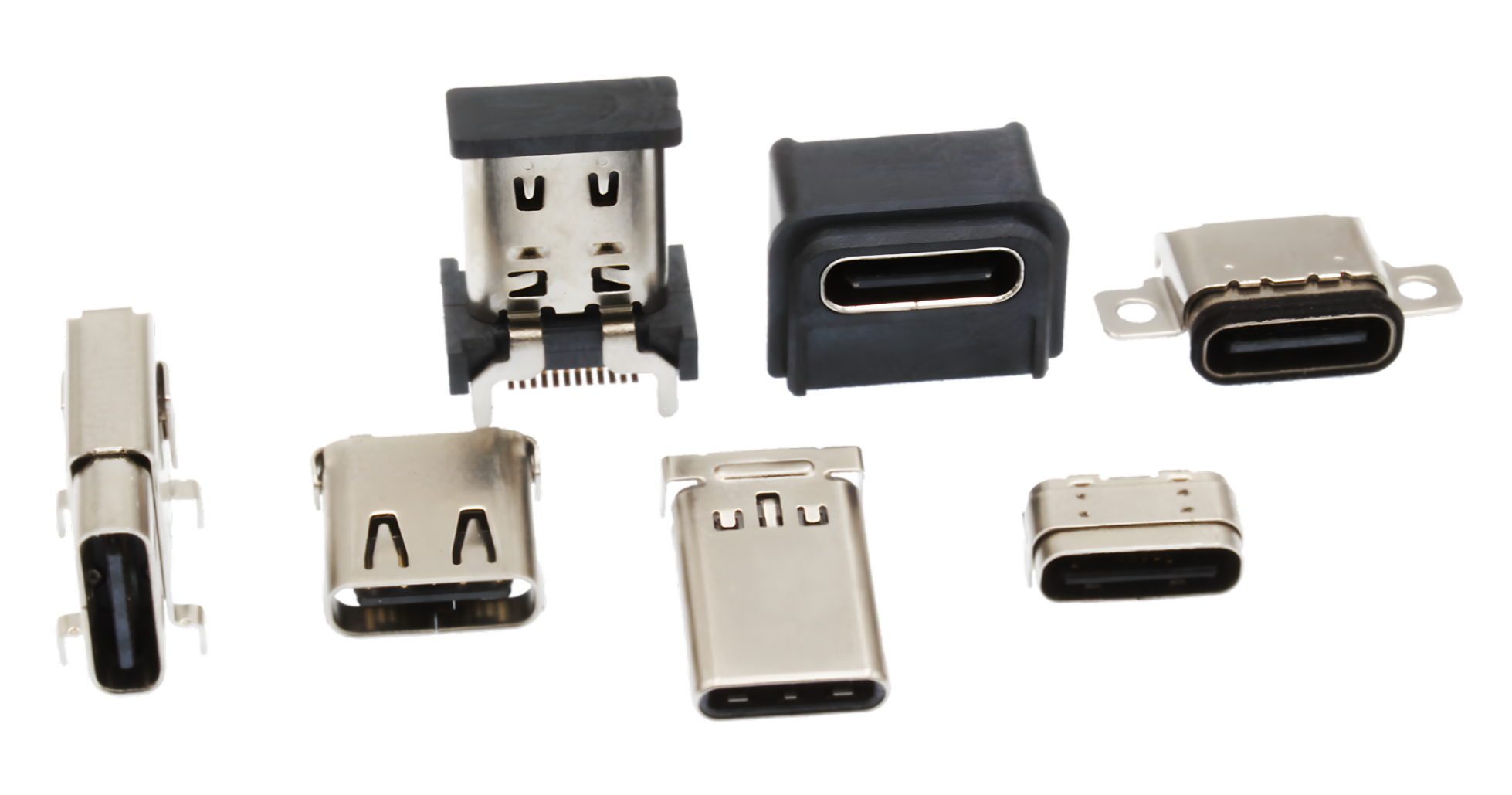
In the realm of wearables, outdoor sensors, and marine electronics, moisture poses a significant threat. USB-C connectors rated IPX8 (such as the USB313WF-02) offer a waterproof seal that safeguards the internal circuitry even when fully submerged. These connectors are frequently designed with side-entry or mid-mount configurations to preserve a slim device profile while ensuring a watertight gasket seal.
Unique Mounting Configurations
Not all PCBs (Printed Circuit Boards) are constructed in the same manner. Depending on the spatial limitations of a device, engineers may need:
Top Mount: Standard positioning on the upper side of the PCB.
Mid-Mount: Embedded within the PCB to minimize the overall height of the device.
Upright/Flag Type: Vertical alignment for space efficiency or specific docking station designs.
Applications: Where is USB-C Heading Next?
The adaptability of the USB-C connector has resulted in its utilization across sectors far exceeding personal computing:
Industrial Automation & Robotics: High-speed data feedback loops and power supply for modular I/O systems.
Automotive: In-vehicle infotainment systems and high-speed diagnostic ports that necessitate vibration resistance and durability.
Energy Storage: Overseeing the interface for portable power stations and smart grid monitoring tools.
Data Storage: External NVMe SSDs that depend on the 20Gbps+ bandwidth of USB 3.2 and USB4 to align with internal drive speeds.
Selecting the Appropriate USB-C Partner: The Importance of Quality
When incorporating USB-C into a product, the quality of the connector has a direct effect on the device's longevity. Inferior connectors can result in signal degradation, port instability, or even electrical shorts. Companies such as Unicorn Electronics (UNE) distinguish themselves by offering an extensive catalog that encompasses every segment of the USB-C market. Whether you require a standard USB 2.0 Type-C for basic charging or a high-performance USB4.0 connector for a sophisticated workstation, their emphasis on precision manufacturing and a variety of mounting options (DIP+SMT, Vertical, Side Entry) guarantees that designers possess the precise tool they require.
Key Factors to Consider When Ordering:
Pitch: The standard 0.5mm pitch is prevalent, but it is essential to verify compatibility with your PCB layout.
Durability: Seek connectors with high mating cycle ratings if the device will undergo frequent plugging and unplugging.
Signal Integrity: For USB 3.2 and higher, confirm that the connector is optimized for high-frequency data to mitigate electromagnetic interference (EMI).
Conclusion
The USB-C revolution is far from complete. As we progress towards a future where a single port accommodates all our power and data transfer needs, the significance of high-quality USB-C hardware cannot be emphasized enough. By utilizing the latest USB4 technology and specialized designs such as waterproof or high-power connectors, manufacturers can develop devices that are faster, more robust, and more user-friendly. If you are in search of premium USB-C solutions for your upcoming project, consider exploring the vast selection at Unicorn Electronics. Their dedication to innovation within the 0.5mm pitch USB Type-C family positions them as a leading choice for global electronic components. Stay connected, stay swift, and embrace the future with USB-C.